Loading Table of Contents...
What Are Keywords? How to Research Keywords for Better SEO
Quick Summary
Collapse
Learn what keywords are, the types of SEO keywords, and how to research, select, and optimize them to reach the right audience and increase website traffic.
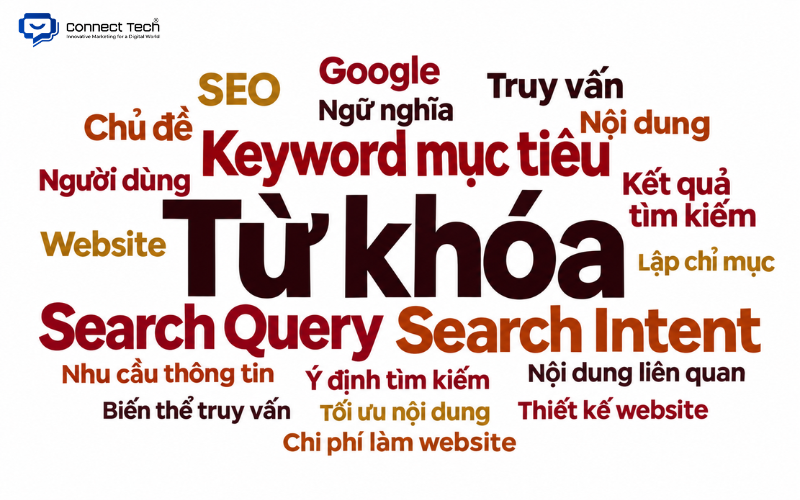
Keywords are words, phrases, or questions that reflect users' needs when searching for information, products, or services on search engines. In SEO, choosing the right target keywords helps websites create relevant content, reach the right customers, and increase their chances of appearing on Google. Join Connect Tech as we explore how to classify, select, and optimize keywords to improve your website's SEO performance.
How Do Keywords Work in SEO?
In SEO, search terms provide a foundation for website owners to identify topics, develop content, and address their customers' information needs.
For example, someone looking to build an e-commerce website might search for phrases such as “e-commerce website design,” “website development costs,” or “reputable web design company.” Each phrase reflects a different need and search intent.
When discussing Google keywords, many people immediately think of the phrases entered into the search bar. However, in SEO, it is important to distinguish between the following three concepts:
|
|
|
|
|
|
|
|
|
|
|
|
|
|
|
|
When a user performs a search, Google analyzes the meaning of the query, identifies relevant content within its index, and displays suitable results.
According to the Google Search Central SEO Starter Guide, search engines can understand the relationship between content and different query variations. Therefore, a webpage can appear for multiple search queries without containing every exact phrase.
Why Are Keywords Important in SEO?
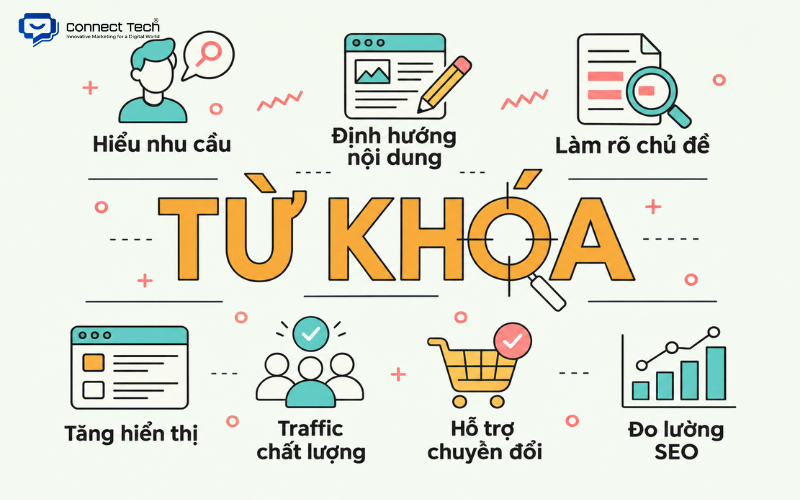
Identifying the right target keywords helps connect website content with users' actual needs. This provides a foundation for developing an SEO strategy that aligns with specific customer segments and business objectives.
The main benefits include:
- Understanding customer needs: Search data reveals what users are interested in, what information they need, and which products or services they are looking for.
- Guiding content development: SEO professionals can identify relevant topics and avoid creating content that does not meet the target audience's needs.
- Helping search engines understand content: Using relevant terminology clarifies the subject and its relationship to search queries.
- Increasing search visibility: Websites have a greater opportunity to appear on search engine results pages (SERPs) when they provide information that meets users' needs.
- Attracting quality organic traffic: Relevant content helps businesses reach people who are genuinely interested in their industry, products, or services.
- Supporting higher conversion rates: Addressing the right search intent can encourage users to register, make purchases, or request consultations.
- Measuring SEO performance: Businesses can track rankings, impressions, clicks, and the queries that attract potential customers.
In practice, a website with high traffic does not necessarily achieve strong business results. What matters is whether its content reaches the right audience and addresses the problems they want to solve.
Common Types of Keywords in SEO
SEO professionals can classify search terms based on their popularity, search intent, role in content, brand association, and geographic location. Each category has distinct characteristics and serves different SEO objectives.
Classification by Popularity and Specificity
Based on search volume distribution and the specificity of user needs, keywords are commonly divided into three groups: short-tail, mid-tail, and long-tail.
|
|
|
|
|
|
|
|
|
|
|
|
|
|
|
|
According to Ahrefs, long-tail keywords are defined by their relatively low search volume rather than the number of words they contain. A query containing several words is not necessarily a long-tail keyword, and vice versa.
Specific search queries often help businesses better understand customer needs. However, competition and conversion potential still depend on the market, content quality, and search intent.
Classification by Search Intent
Search intent refers to the actual purpose behind a user's query. Understanding this factor helps you choose the appropriate content type for each search need.
|
|
|
|
|
|
|
|
|
|
|
|
|
|
|
|
|
|
|
|
|
|
|
|
|
A single query can reflect multiple search intents. Therefore, you should examine the results currently appearing on Google to identify the dominant user need before developing content.
Classification by Role in Content
When creating SEO-friendly articles, the selected keywords typically serve different purposes.
|
|
|
|
|
|
|
|
|
|
|
|
|
|
|
|
|
|
|
|
These groups should work together naturally to create comprehensive content. You do not need to include every keyword variation if it does not provide useful information to readers.
Classification by Brand and Geographic Location
This classification is particularly useful for businesses looking to increase brand awareness or reach customers in specific geographic areas.
- Branded keywords: Contain a brand name, such as “Connect Tech SEO services.”
- Non-branded keywords: Do not contain a brand name, such as “comprehensive SEO services.”
- Local keywords: Reflect search needs within a particular geographic area, such as “SEO company in Ho Chi Minh City.”
Branded queries often come from users who are already familiar with a business. Meanwhile, non-branded keywords help expand reach to new customers, while local keywords allow businesses to connect with people searching for services in a relevant geographic area.
How to Research and Choose the Right Keywords for SEO
To choose effective target keywords, you need to consider search demand, competition, your ability to develop content, and the value those terms bring to your website. Instead of focusing solely on search volume, follow these three steps.
Step 1: Identify Your Topic and Expand Your Keyword List
Start by identifying your industry, target audience, and the problems your customers are facing. Then, select several seed keywords that represent the products, services, or topics you want to cover.
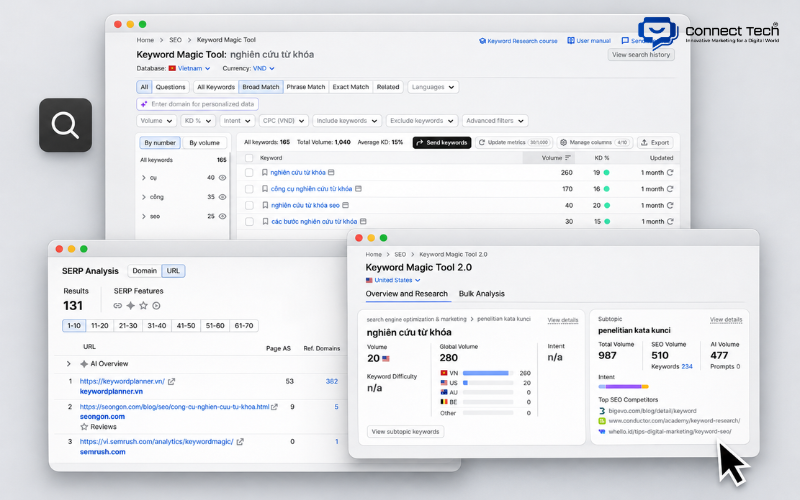
You can find keywords on Google through features such as Google Autocomplete, People Also Ask, and related search queries suggested on the search results page.
Additionally, reviewing competitors' websites, examining customer questions, and using SEO tools can help expand your list and uncover search needs that your website has not yet addressed.

Step 2: Analyze Keyword Metrics and Search Potential
SEO metrics help you evaluate market demand and competition before deciding which content to develop.
|
|
|
|
|
|
|
|
|
|
|
|
|
|
|
|
|
|
|
|
|
|
|
|
Tools such as Ahrefs and Semrush use different methods to collect data, calculate keyword difficulty, and estimate traffic. Therefore, results may vary between platforms and should not be considered official ranking scores provided by Google.
Furthermore, CPC and advertising competition in Google Ads do not directly reflect organic SEO difficulty.
Step 3: Group Keywords and Choose Suitable Content for Each Page
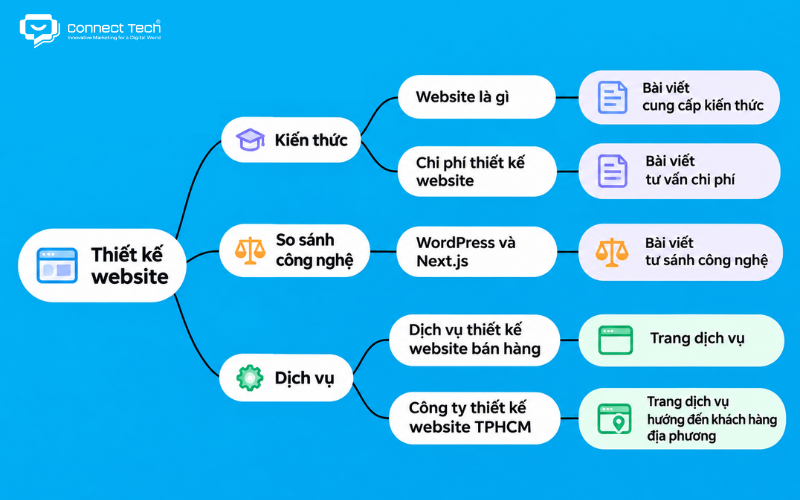
Once you have completed your list, group keywords that share the same search intent and identify the most suitable page for each group.
For example, a business offering website design services could organize its keywords as follows:
|
|
|
|
|
|
|
|
|
|
|
|
|
|
|
|
|
|
This approach to keyword grouping and mapping helps websites establish a clear content structure while supporting the development of topic clusters and internal linking systems. It also helps reduce the risk of creating multiple pages that address the same search need.
How to Use Target Keywords in SEO-Friendly Articles
An SEO keyword is used effectively when it helps both readers and search engines understand the content of a webpage. This does not mean you need to repeat the primary keyword in every part of an article.
Use Keywords in Important Locations
Several on-page SEO elements help communicate the main topic and provide information about a webpage's content.
|
|
|
|
|
|
|
|
|
|
|
|
|
|
|
|
|
|
|
|
|
|
|
|
|
|
|
|
|
|
Each element serves a different purpose. For example, a meta description helps users understand the content before visiting a webpage, while alt text describes images and improves accessibility.
You should optimize each element according to its intended function rather than forcing the same phrase into every location.
Distribute Keywords Naturally and Within the Right Context
SEO-friendly content should prioritize readability and the ability to meet users' needs. You can combine alternative expressions, industry terminology, and concepts related to the main topic.
For example, when writing about website design, you can discuss UX/UI design, responsive design, page loading speed, domain names, hosting, and content management systems (CMS) where relevant.
These elements add depth to the article without requiring constant repetition of the primary keyword.
Google also does not specify an ideal keyword density. Instead of trying to achieve a fixed percentage, focus on explaining the subject comprehensively using natural, accurate, and easy-to-understand language.
Tools for Keyword Analysis and Tracking
SEO tools help you discover search demand, evaluate competition, and monitor content performance after publication.
|
|
|
|
|
|
|
|
|
|
|
|
|
|
|
|
|
|
|
|
|
|
|
|
|
|
|
|
If you have a limited budget, Google Trends is a useful free keyword research tool for discovering topics that are attracting public interest.
If you want to know how to find trending keywords on Google, visit Google Trends, use the Trending Now feature, and select Vietnam along with an appropriate time range. You can also explore rising related queries to identify new content opportunities.
Keep in mind that Google Trends uses a relative scale from 0 to 100 to represent search interest rather than actual search volumes.
After publishing content, you can use Google Search Console to identify the queries generating impressions and clicks. By combining this information with conversion data from Google Analytics 4 (GA4), businesses can better evaluate SEO performance and identify content that needs improvement.
Choosing the right target keywords provides a foundation for creating relevant website content, increasing search visibility, and reaching potential customers. To achieve long-term results, you need to combine search demand analysis, natural content optimization, and regular performance monitoring.
If you want to improve your website's SEO performance, explore more educational articles from Connect Tech or contact us for advice on a comprehensive SEO strategy tailored to your business objectives.

Table of Contents