Loading Table of Contents...
Hosting Vietnam vs AWS: An In-Depth Technical Analysis
Quick Summary
Collapse
Compare Vietnam Hosting and AWS from a technical perspective, including performance, IOPS, SLA, security, and cost. Connect Tech provides an in-depth analysis to help businesses choose the most suitable infrastructure solution.
Choosing a hosting infrastructure not only affects website loading speed but also determines the scalability, stability, and operating costs of the entire website system. When building a website, many businesses often hesitate between two popular options: Vietnamese Hosting and Amazon Web Services (AWS).
In reality, there is no single solution that fits every business. Each model is built on a different architecture and addresses specific operational requirements. Therefore, before making a decision, businesses need to evaluate important factors such as network latency, storage performance, scalability, system availability, and long-term investment costs.
Comparing Vietnamese Hosting and AWS in Terms of Infrastructure Architecture
Hosting services in Vietnam are commonly deployed in the form of Shared Hosting or VPS. Resources are allocated from physical servers located in domestic data centers, and users manage them through tools such as cPanel or DirectAdmin. In addition, most system operation and maintenance tasks are supported by the service provider.
In contrast, AWS is built on a distributed cloud-native computing model. Instead of relying on a single server, the infrastructure is divided into multiple independent services such as Amazon EC2 for computing resources, Amazon RDS for databases, Amazon S3 for data storage, Elastic Load Balancer for load balancing, and CloudFront for a global CDN system.
Thanks to this architecture, AWS offers virtually unlimited scalability while minimizing the risk of service interruption when a server or system component encounters a failure.
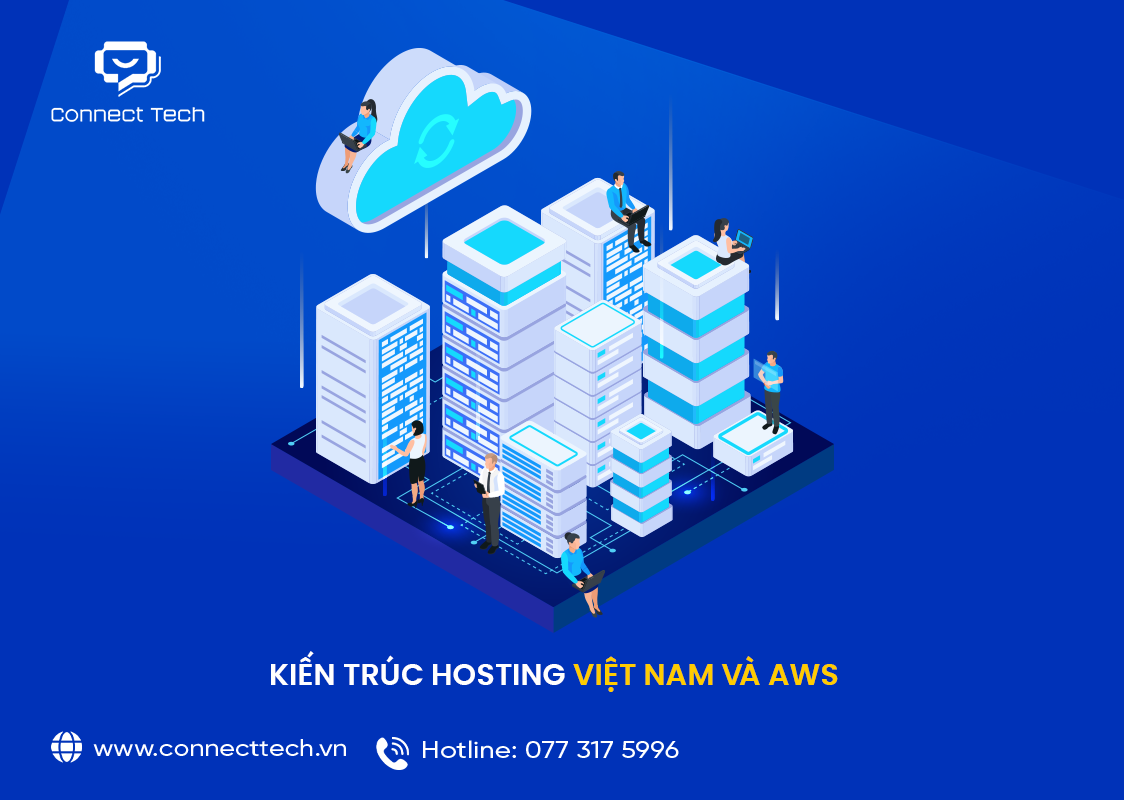
Vietnamese Hosting and AWS Architecture
Technical Analysis Based on Key Criteria
Bandwidth and Network Latency
Network latency is the amount of time it takes for data to travel from the user's browser to the server and back. This factor directly affects page loading speed and the user experience.
For servers located in Vietnam, response times typically range from 5–20ms due to the short geographical distance. This allows websites to load faster, especially those using many images, videos, or JavaScript resources.
Meanwhile, AWS currently does not have a Region in Vietnam. The nearest data center is located in Singapore (ap-southeast-1), resulting in access latency from Vietnam typically ranging from 40–80ms. Under normal conditions, this difference is not significant. However, when international submarine fiber optic cable incidents occur, response times can increase considerably, leading to reduced page loading speed, poorer user experience, lower conversion rates, and decreased SEO performance.
Therefore, for websites that primarily serve domestic customers, servers located in Vietnam still have a clear advantage in access speed.
Data Read/Write Performance (IOPS)
IOPS (Input/Output Operations Per Second) is a metric that measures the number of read and write operations a storage system can process in one second.
For standard corporate websites, IOPS is not a critical factor. However, for e-commerce systems, CRM, ERP, or websites with high traffic and numerous database queries, this metric directly impacts operational performance.
Many Vietnamese hosting providers currently use Enterprise SSDs or NVMe storage but do not provide specific IOPS commitments. When multiple websites share the same resources, storage performance may decline significantly.
In contrast, AWS allows businesses to choose suitable storage types such as General Purpose SSD (gp3), Provisioned IOPS SSD (io2), or Throughput Optimized HDD (st1). As a result, businesses can configure tens of thousands of IOPS to support systems that require continuous transaction processing and high traffic volumes.

IOPS Specifications for Enterprise Hosting
Resource Scalability
Website traffic can increase dramatically within a short period. If the infrastructure cannot accommodate the demand, the system may become overloaded or stop functioning.
With Vietnamese Hosting, resource upgrades are usually performed manually by increasing RAM, upgrading CPU resources, or migrating to a higher VPS package. In some cases, businesses even need to move to a new server, creating the risk of service interruption.
By contrast, AWS is designed to scale according to actual demand. Services such as Auto Scaling Group, Elastic Load Balancer, Amazon ECS, and Kubernetes (EKS) allow the system to automatically increase or decrease resources based on traffic.
For example, during major promotional campaigns, an e-commerce website may grow from a few thousand to tens of thousands of concurrent users. AWS can automatically provision additional resources to maintain performance without disrupting services.
High Availability and Fault Tolerance
One factor that is often overlooked when selecting infrastructure is the ability to maintain continuous system operation.
Most Hosting or VPS packages in Vietnam operate on a single server or within a single data center. When hardware failures occur, the website may experience downtime until the recovery process is completed.
Meanwhile, AWS is built on a Multi-AZ model. Data and applications can be deployed simultaneously across multiple servers in different Availability Zones. When one component fails, traffic is redirected to another server, and databases can automatically fail over, allowing the system to continue operating with virtually no interruption.
This is a critical requirement for businesses in finance, e-commerce, fintech, or SaaS platforms with large transaction volumes.
SLA Commitments
SLA (Service Level Agreement) is a commitment regarding service uptime.
Many Vietnamese hosting providers advertise uptime levels ranging from 99% to 99.9%. Meanwhile, AWS provides higher availability commitments for individual services, such as Amazon EC2 at 99.99%, Amazon RDS Multi-AZ at 99.95%, and Amazon S3 at 99.99%.
This seemingly small difference has significant implications in practice. An uptime of 99% is equivalent to approximately 87 hours of downtime per year, 99.9% is equivalent to nearly 9 hours, while 99.99% results in only about 52 minutes of downtime. For businesses that depend on online operations, service interruptions can cause substantial losses in both revenue and brand reputation.
Security and Compliance Systems
Domestic hosting providers typically equip their services with basic security solutions such as Firewalls, Anti-DDoS protection, data backup, and WAF. These technologies adequately meet the requirements of corporate websites and service-oriented websites.
Meanwhile, AWS provides a comprehensive security ecosystem with many specialized services such as AWS Shield, AWS WAF, GuardDuty, Security Hub, IAM, and KMS. In addition, the platform complies with numerous international standards, including ISO 27001, PCI DSS, SOC 1, SOC 2, SOC 3, and HIPAA.
For businesses operating in finance, healthcare, or technology, these requirements are almost mandatory to ensure compliance and data security.

Hosting Security for Businesses
Conclusion
There is no universal answer when choosing between Vietnamese Hosting and AWS. If the priorities are domestic access speed, reasonable costs, and simple operations, Vietnamese Hosting is an appropriate choice. On the other hand, if a business requires a flexible platform with strong scalability and the ability to meet global operational standards, AWS will be the optimal solution. At Connect Tech, we have implemented numerous website systems for businesses in real estate, e-commerce, industrial, and service sectors.
Our technical team will analyze traffic volume, scalability requirements, and investment budgets to recommend the most suitable infrastructure model for each project.
Contact Information
Address: 965/36/9 Quang Trung, An Hoi Tay Ward, Ho Chi Minh City
Hotline: 077 317 5996
See more related articles:
How Does UX/UI Affect Service Industry Websites?
What Is the Difference Between a Service Website and an eCommerce Website?
Why Do Service Industry Websites Fail to Generate Leads? Solutions and Fixes

Table of Contents