Loading Table of Contents...
What Are Amazon Selling Fees? A Beginner's Guide
Quick Summary
Collapse
Explore all types of Amazon selling fees with detailed calculations and cost-saving strategies, making it easier for beginners to start selling online today.
Amazon is one of the largest e-commerce platforms in the world, offering global business opportunities for all sellers. However, to sell effectively and profitably, it's essential to understand Amazon's selling fees, as they directly impact your margins.
This article will help you clearly understand the different types of Amazon selling fees, how they are calculated, and tips to optimize costs — especially useful for those who are just starting out on Amazon.

I. What Are Amazon Selling Fees?
Amazon selling fees refer to all the costs that sellers must pay to maintain their business operations on the Amazon platform. These fees are deducted directly from sales revenue and include both fixed and variable charges, depending on the seller’s business model and scale.
In general, Amazon selling fees can be categorized into two main groups:
- Fixed costs: These include fees such as the monthly subscription for a Professional Selling Plan, which are charged regardless of whether you make any sales.
- Variable costs: These are expenses that arise per order or based on the volume of goods sold, such as referral fees, fulfillment fees, storage fees, or shipping fees.
II. Fees that must be paid when selling on Amazon
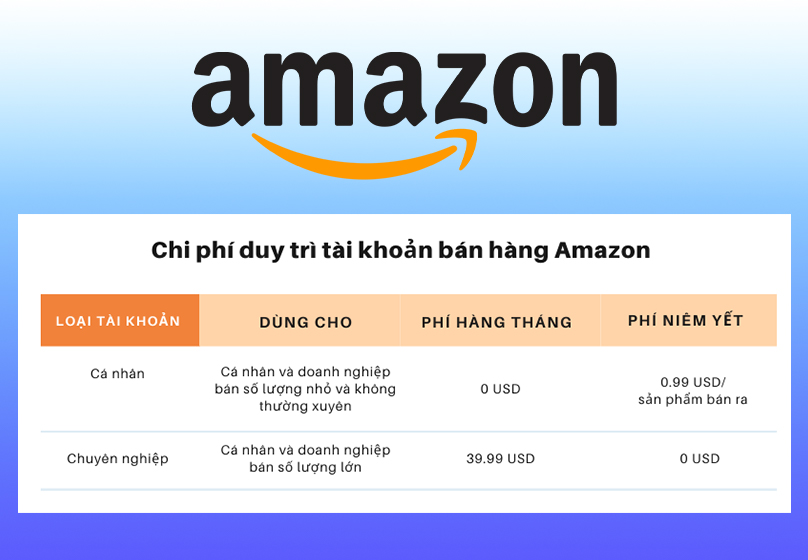
1. Account maintenance fee for sellers
This is the fee required to maintain your selling privileges on Amazon.
Individual Seller Account (costs 0 USD/month):
- No monthly fee, but many features are limited.
- Suitable for small-scale sellers with sales of 40 items or fewer per month.
- You must list products manually, cannot connect to inventory management systems, and gift wrapping services are not available.
Professional Seller Account (costs 39.99 USD/month):
- Designed for high-volume or serious sellers.
- There is no limit on the number of items sold, and it supports bulk uploads and inventory management integration.
- This fee essentially acts as a "professional storefront rental" that grants access to Amazon's full suite of selling tools.
2. Referral fee
This is the commission Amazon charges on each product sold — similar to a “brokerage fee” for bringing customers to you.
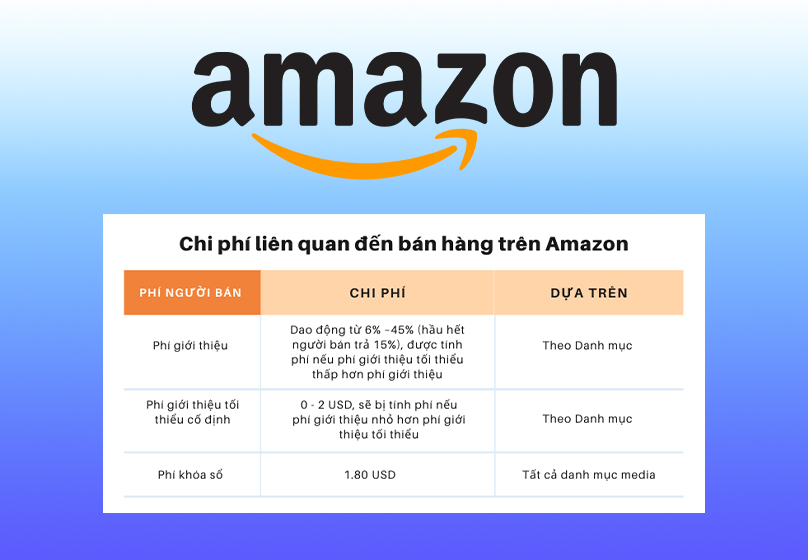
- It is calculated as a percentage of the selling price, averaging around 15%, but ranging from 6% to 45% depending on the category.
- Some categories have a minimum referral fee. For example, the Pet Supplies category has a 15% referral fee with a minimum of 0.3 USD.
- If you sell a rope for 1.8 USD → 15% equals 0.27 USD, which is less than the minimum, so Amazon will charge 0.3 USD.
3. Closing fee
This is a fixed transaction handling fee applied to certain special categories such as Books, DVDs, Music, and Games.
- The current rate is 1.80 USD per item.
- Simply put, it's a “transaction completion fee” that Amazon charges for products in digital content or copyrighted categories.
4. Shipping costs
This cost is not paid directly to Amazon (unless you're using FBA), but it still affects your profit:
- If you handle shipping yourself, Amazon provides a shipping credit, but it often doesn’t fully cover the actual shipping expense.
- For international orders or heavy/bulky items, if not calculated carefully, shipping fees can eat up all your profit.
5. FBA service fee (Fulfillment by Amazon)
This is the fee you pay when using Amazon’s warehousing and delivery service. Essentially, Amazon handles three tasks for you:
1. Receiving and storing your inventory
2. Packing and delivering orders to customers
3. Handling returns and customer service
Main types of FBA fees:
- Order handling fee: Calculated based on the size and weight of the product.
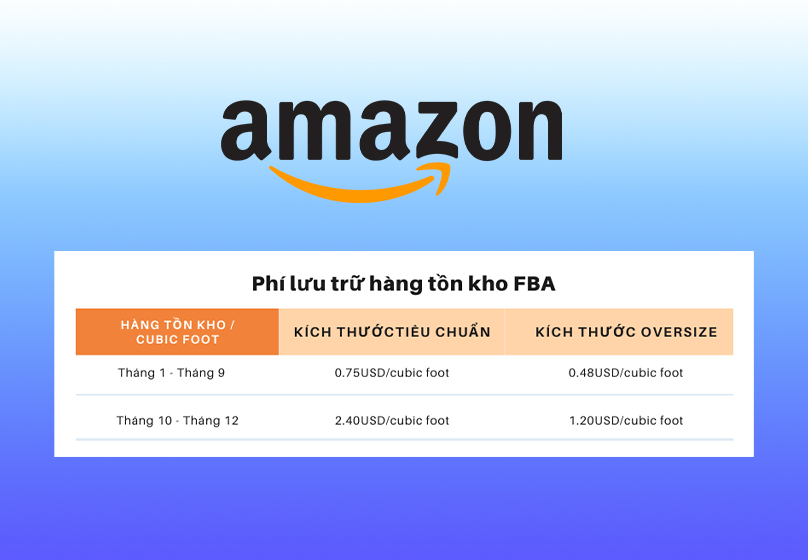
- Storage fee: Charged according to the warehouse space used (in cubic feet). This fee increases during the year-end peak season due to higher storage demand.
The advantage is that your products become eligible for Prime, which encourages faster purchases. However, if you have large inventory or slow-moving items, storage fees can rise significantly.
Read more: What is FBA Amazon? A Detailed Guide to Fulfillment by Amazon
III. Example: How to Calculate Amazon Selling Fees
3.1. Calculating fees for an Individual Seller account
Example:
- Product: Paperback book
- Selling price: $25
- Shipping fee (paid by buyer): $5
- Category: Books (15% referral fee, closing fee applies)
Calculation method:
Total revenue: 25 USD (selling price) + 5 USD (shipping) = 30 USD
Referral fee: 15% × 25 USD = 3.75 USD
Closing fee: 1.80 USD (applies to books)
Per-item fee: 0.99 USD (charged for Individual Seller account)
Amount received: 30 − 3.75 − 1.80 − 0.99 = 23.46 USD
3.2. Fee Calculation for a Professional Seller Account
Example:
- Product: Book
- Price + shipping fee paid by customer: 30 USD
- Actual shipping fee paid by seller: 5 USD
- Account: Professional – 39.99 USD/month
- No unit fee of 0.99 USD (waived)
- Account fee divided by ~100 orders/month → 0.40 USD/order
Calculation method:
Total revenue: 30.00 USD
Referral fee (15%): 4.50 USD (30 × 15%)
Closing fee: 1.80 USD
Account maintenance fee (prorated): 0.40 USD
Actual shipping cost (assumed): 5.00 USD
Amount received: 30 – 4.50 – 1.80 – 0.40 – 5.00 = 18.30 USD
3.3. Example with specific category – Watches
Example:
- Product: Watches
- Selling price: 200 USD
- Shipping fee paid by customer: 0 USD → seller pays shipping fee
- Actual shipping fee (assuming FBM): 10 USD
- Referral fee for Watches category: 16% for value under 1,500 USD
- No closing fee applies
- Comparison between Personal and Professional Accounts
- Professional Account: maintenance fee of 39.99 USD/month, averaged over 100 orders → 0.40 USD/order
Calculation method:
1. Individual Seller
- Item Amount (USD)
- Product Selling Price 200.00
- Referral Fee (16%) -32.00
- Unit Fee -0.99
- Actual Shipping Fee (Assumed) -10.00
- Total Received: 200 – (200 x 16%) – 0.99 – 10 = 157.01 USD
2. Professional Seller Account
- Product price 200.00
- Referral fee (16%) -32.00
- Account maintenance fee (shared equally) -0.40
- Actual shipping fee (assumed) -10.00
- Total amount received = 200 – (200 x 16%) – 0.40 – 10 = 157.60 USD

3.4. Example: Calculating Return Processing Fees
Scenario 1: Returning a single item
- Amazon charges a maximum of $5.
- If the return processing fee is $3 → Amazon only charges $3.
Scenario 2: Returning multiple items at once
- Amazon calculates the fee separately for each item, but no more than $5 per item.
Scenario 3: Low-value products
- For products priced around $6–$7, the return fee can eat up almost all of your profit.
- It’s important to account for extra costs and have a clear return policy when selling such items.
IV. Tips to optimize costs when selling on Amazon
The cost of selling on Amazon can quickly reduce profits if not managed effectively. Below are tips to help you minimize costs, increase profit margins without affecting service quality.
4.1. Optimize shipping costs
Shipping costs are one of the biggest expenses for sellers, especially if they self-fulfill (operate their own warehouse and ship their goods). To optimize, you need to do the following:
- Use Amazon's fee calculator: Before listing your price, you should use a tool like the FBA Revenue Calculator to estimate shipping costs and net profits for each fulfillment option.
- Choose a reputable carrier: Compare costs and reliability between carriers such as DHL, FedEx, UPS, USPS. Each carrier has its own strengths, and some offer discounted prices for Amazon sellers.
- Optimize packaging: Design compact packaging, use standard materials but not excessive. Reducing unit size/volume helps save on FBA fees and international shipping costs.

4.2. Optimize advertising costs (Amazon Ads)
Amazon Ads is a powerful tool for increasing product visibility, but it can also be a drain on your bottom line if not managed carefully.
- Focus on high-performing keywords: Don’t run ads on a ton of keywords. Instead, track and prioritize keywords with high conversion rates (CVR) and low costs.
- Monitor and tweak your campaigns regularly: Review your ad data at least weekly to turn off ineffective keyword ads, adjust bids, and allocate budgets to potential campaigns
- Use tools: Use software like Helium 10, Jungle Scout, or Amazon Advertising Console to analyze your campaign’s CPC and ROI, and come up with smarter strategies.
4.3. Optimize customer reviews
Good reviews help build trust and reduce the risk of returns, thereby significantly saving on additional costs.
- Quick and professional response: Respond to all questions and complaints within 24 hours to maintain a good account quality score and create goodwill with customers.
- Use review support software: Some software such as FeedbackWhiz, Sellerboard help you automatically send emails requesting product reviews, gently reminding satisfied customers to leave positive reviews.
- Optimize the experience to reduce returns: Write accurate and honest product descriptions, provide clear photos and introductory videos if available, and provide clear instructions to limit product misunderstandings.

V. Important notes for Vietnamese sellers
Selling on Amazon is a great opportunity, but it also comes with its own set of challenges. Understanding the potential risks and costs will help you avoid problems down the road.
5.1. Hidden costs that can cause losses
Many new sellers often only calculate the basic costs, but ignore hidden costs that can reduce profits.
- Ineffective PPC advertising: If you don't know how to optimize Amazon Ads, you will spend a lot but your orders will not increase. This is especially common when running ads based on emotions, not data.
- High return costs for bulky products: Items such as furniture, electronics, or fragile products have a high risk of being returned. The logistics cost of processing returns can be twice as high as profits if not controlled.
- Long-term storage costs: If a product is in stock for more than 365 days, Amazon will charge additional long-term storage fees, causing losses. Sellers need to proactively forecast demand and rotate goods regularly.
5.2. Copyright & Counterfeit Risks
Amazon has a very strict policy on intellectual property, and new sellers from Vietnam often lack knowledge in this area.
- Being reported for intellectual property violations: Whether intentionally or unintentionally, selling copyrighted goods (e.g. printing cartoon characters, big brands) can result in your account being warned or permanently locked.
- Listing hijacking: Products without a registered brand are easily "jumped in" for sale by others, occupying the Buy Box or dropping ratings.
- Register for brand protection early: Registering for Brand Registry helps protect listings, opens up the right to run A+ Content ads, and enhances brand reputation.
5.3. Amazon accounts are easily locked
Amazon strictly controls seller behavior. If you do not comply with the policy, your account may be locked without notice.
Policy violations: Including creating multiple accounts with the same information, spamming reviews, copyright infringement, or providing false information about the product.
Poor sales performance: Indicators that can easily cause you to be warned such as late delivery, high cancellation rate, not updating but tracking the shipping (tracking number)
Note: If you use FBA, Amazon will help you process orders, deliver on time, and minimize operational risks and account metrics.

VI. Conclusion
Selling on Amazon is a great opportunity to reach the global market, but it also has many potential challenges, especially in terms of costs. If you do not understand the fee structure and how the platform operates, sellers can easily fall into a loss situation despite high sales.
To do business effectively, you need to master the types of fees, optimize the operating process, control advertising and comply with Amazon's policies. For beginners, start small, learn each step firmly and build a systematic system before expanding. This is a solid foundation for long-term and sustainable development on Amazon.
If you are looking for a reputable support unit right from the beginning, Connect Tech's Amazon service is ready to help you set up a booth, optimize costs and operate effectively. Sign up for a free consultation today!

Table of Contents