Loading Table of Contents...
Professional Education Website Design for Schools and Training Centres
Quick Summary
Collapse
Education website design for schools, training centres and learning platforms. Explore features, pricing, technology and solutions from Connect Tech.
An effective education website needs more than an attractive interface. It should help parents, learners and internal teams find the right information, submit enquiries and use the functions they need.
Every education provider operates differently, so one website model cannot fit every project. This article helps you identify the right type of website, essential functions, pricing, a real case study and Connect Tech’s approach to education website projects.
Choose the Right Website Solution for Each Education Model
The education model determines which structure, content and functions a website should prioritise. Two organisations in the same education sector may still need completely different solutions if they serve different users or follow different enrolment processes.
|
|
|
|
|
|
|
|
|
|
|
|
|
|
|
|
|
|
|
|
Education Website Functions Connect Tech Can Develop
Connect Tech can develop functions based on the actual scope of each project instead of placing every feature into a fixed package. This approach helps education providers invest in what they currently need while keeping room for future expansion.
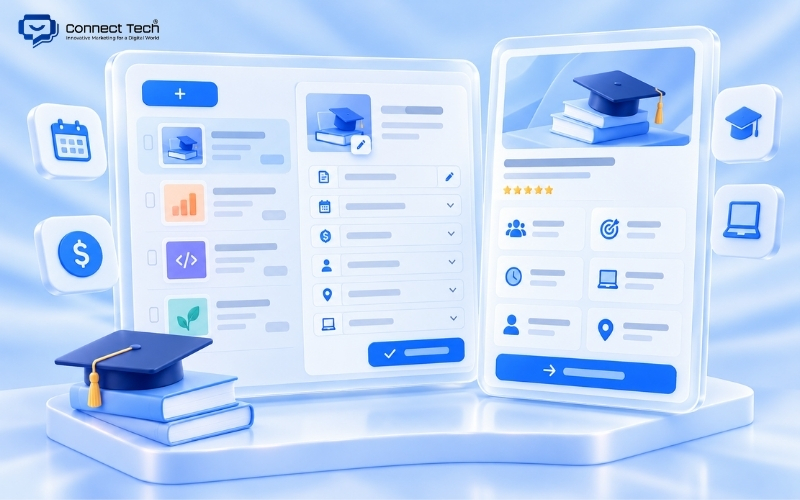
Programme and Course Management
The content management system should allow staff to update programmes without depending on developers for routine tasks. Administrators can add courses, edit descriptions, update schedules, tuition fees, instructors, locations, learning formats and calls to action.
A programme page should answer the learner’s main questions directly. The content should explain who the course is for, what learners can achieve, how long the programme takes, how classes are delivered, who teaches the course and what the learner should do next.
Admissions, Consultation Registration and Class Schedules
The website should turn initial interest into a simple enquiry process. Users should be able to review a programme, select their needs, submit a form and receive the next steps without having to call the organisation for basic information.
A typical journey may follow this flow: Course → Registration form → Lead → Admissions team → Consultation. The system can send submitted information through email, a CRM or an API depending on the organisation’s workflow.
Registration forms should only collect information required for the initial consultation. A concise form makes completion easier for users and helps the organisation avoid storing unnecessary data.
Teacher Profiles, News and Trust-Building Content
The website should provide evidence that helps parents and learners evaluate an education provider before registering. Teacher profiles, campus photos, student activities, achievements, certifications and professional content can communicate the organisation’s capabilities more clearly.
The marketing team also needs an easy-to-use CMS for publishing news, events and SEO content. When the content team can manage publishing independently, the website can support long-term growth instead of functioning only as an online brochure.
Search, Filters and Content Classification
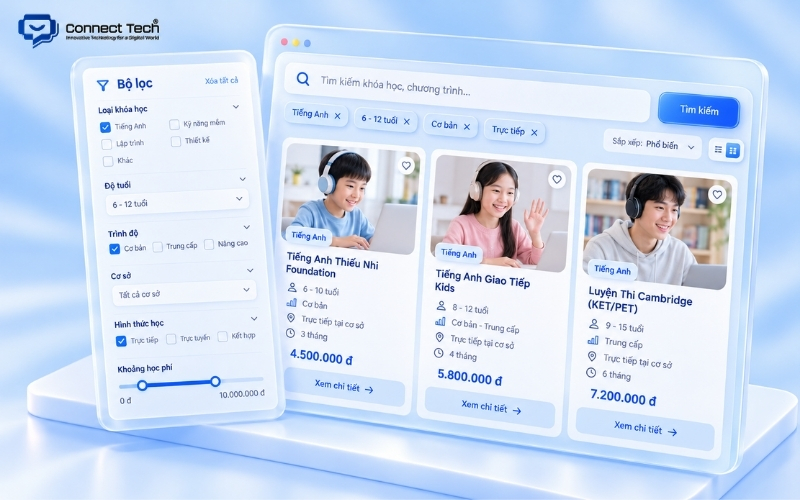
Websites with many programmes should help users narrow their options quickly. The system can provide filters based on course type, age, level, location, learning format, schedule or tuition range when the available data supports these options.
Filters should only be introduced when the number of programmes makes them useful. A website with only a small number of courses can use a simpler category structure to avoid unnecessary complexity.
User Accounts, LMS and System Integrations
User accounts are useful when the website contains private content or data for different user roles. The system can assign permissions to administrators, content editors, teachers, learners or parents depending on the organisation’s requirements.
An LMS is suitable when the organisation needs to manage lessons, videos, documents, quizzes, assignments, learning progress and certificates. If the organisation already uses Moodle, Google Classroom or another platform, Connect Tech can evaluate an integration instead of rebuilding similar functions.
The website can also connect with payment gateways, CRM platforms, SIS solutions, email, SMS, Zalo, Google Analytics 4 or internal APIs. These integrations should be identified during the discovery stage so the technical team can assess the correct scope and cost.
Multilingual Websites
A multilingual website is suitable for international schools, language centres or organisations recruiting international learners. The system should provide separate URLs for each language and allow corresponding content to be managed properly to support both users and international SEO.
Education Website Design Pricing at Connect Tech
Connect Tech offers three website packages priced at VND 6 million, VND 10 million and VND 15 million, allowing clients to choose according to the scale of their website. Each package suits a different level of demand, ranging from a basic information website to a more customised website with additional functions for admissions and marketing.
|
|
|
|
|
|
|
|
|
|
|
|
|
|
|
|
|
|
|
|
Education Website Case Study by Connect Tech
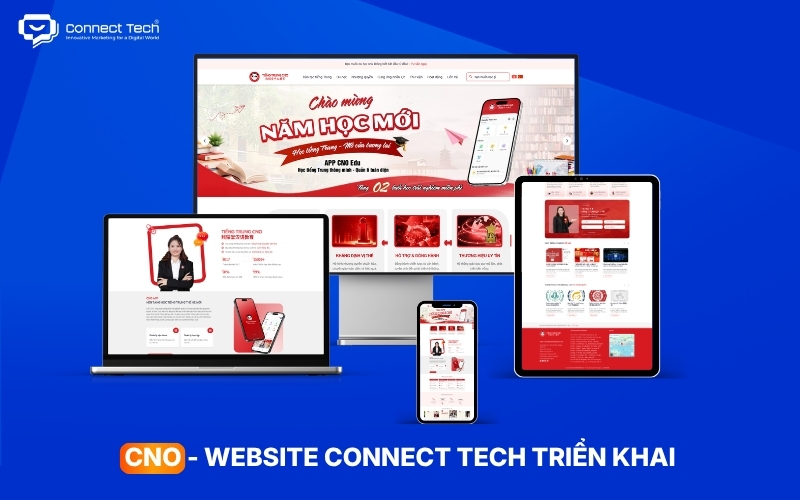
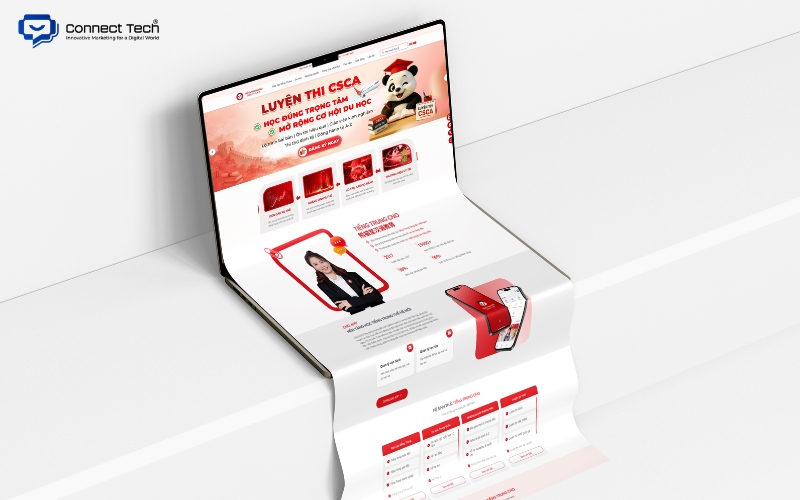
Connect Tech developed a website for CNO, an education ecosystem providing Chinese-language training, exam preparation, study-abroad services and franchise opportunities.
CNO's Challenge
CNO needed a website that could organise several service groups while still helping users find relevant information easily. Learners, parents and users interested in studying abroad or franchise opportunities have different goals, so the website structure needed to separate these journeys clearly.
The website also needed to demonstrate CNO's educational capabilities through its programmes, achievements, team and other trust-building information. The user journey needed to move visitors from initial research to enquiry without overwhelming them with too many service categories.
How Connect Tech Structured the Solution
Connect Tech created an information architecture that gave each programme group a clear place within the website. The project team organised service pages, consultation CTAs, trust-building content and a bilingual structure based on the brand's direction.
The system also considered future connectivity with CNO EDU so the marketing website and the learning system could support each other. The website attracts and guides users, while the dedicated education system continues to manage learning-related operations.
Why Choose Connect Tech for an Education Website Project?
Connect Tech focuses on understanding the actual business and operational requirements before recommending an interface or technology. This approach is particularly suitable for education projects because every school, training centre and learning platform has a different admissions process, content structure and management system.
Business Requirements Are Reviewed Before the Solution Is Finalised
Connect Tech first needs to understand users, programmes, the admissions process and any systems already in use before developing the sitemap. This information helps the project team determine which functions should be built immediately and which can be developed in later phases.
Clients should prepare several types of information before the project begins:
- The organisation should provide a list of its current programmes or courses.
- The organisation should provide its logo, brand guidelines and available images.
- The admissions team should explain how leads are currently received and processed.
- The technical team should list any LMS, CRM, SIS or other software currently in use.
- The project owner should confirm required languages and the people responsible for content approval.
Flexible Technology Selection
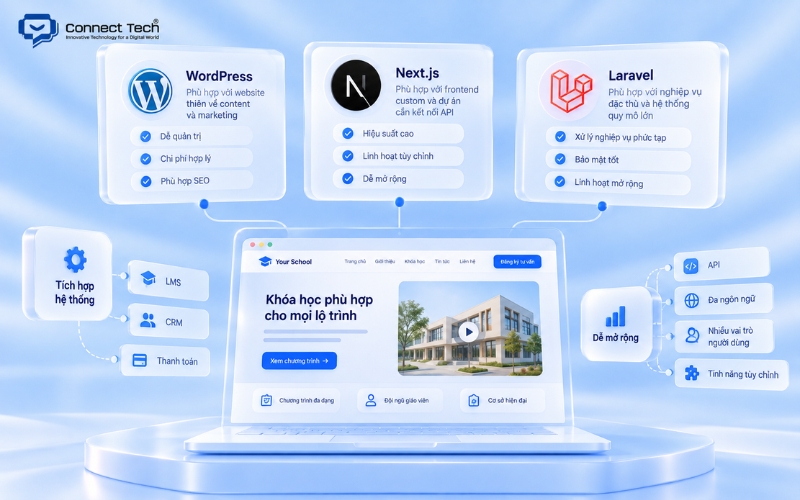
Connect Tech can recommend WordPress for content- and marketing-focused websites, Next.js for custom frontends and API-connected projects, or Laravel and custom systems for specialised workflows. The project team selects technology after defining requirements rather than forcing every project onto the same platform.
This approach helps clients balance initial investment, ease of management and future scalability. A simple website does not need an unnecessarily heavy system, while a platform with multiple user roles and data flows requires the right architecture from the beginning.
UI/UX, Technology and SEO Work Together
Connect Tech treats a website as a platform that supports users and marketing activities rather than simply as an interface. The project team considers content structure, CTAs, responsive design, speed, metadata, internal linking and content management during the development process.
This approach gives an education website a stronger foundation for SEO and advertising after launch. Google Search, Search Console, Google Analytics 4 and Core Web Vitals can help marketing teams track visibility, traffic and real-world user experience.
Practical Experience with Education Projects
Connect Tech has direct experience handling websites with multiple programmes, different user groups and connections between marketing websites and education systems. This experience allows the project team to focus on user journeys and operational requirements rather than applying a generic industry template.
If you are planning to build or redesign a website for a school, training centre or learning platform, Connect Tech can help define the sitemap, required functions and technical solution before development begins.
Frequently Asked Questions About Education Website Design
The following questions address common concerns that organisations have before finalising the scope of an education website project.
Does an Education Website Need an LMS?
An education website does not always need an LMS. A school or training centre that mainly uses its website for information and admissions can operate effectively without an online learning management system.
An LMS is useful when the organisation needs to manage lessons, videos, documents, quizzes, assignments, learning progress or certificates. If the organisation already uses Moodle, Google Classroom or another platform, the technical team can consider an integration instead of rebuilding the same functionality.
Should an Education Website Use WordPress, Laravel or Next.js?
The right platform depends on the organisation's workflows and future development plans. WordPress often suits content-focused websites, Next.js suits custom frontends and API integrations, while Laravel or a custom system works well for specialised workflows and multiple user roles.
The organisation should define its required functions before choosing the technology. This approach prevents the project from selecting a platform first and then changing operational requirements to fit technical limitations.
Does an Education Website Need SEO?
An education website needs an SEO-friendly structure if the organisation wants its programmes and content to appear on Google. The system should provide clear URLs, metadata, a sitemap, internal links, crawlable content and dedicated pages for important programmes.
Google continues to use standard SEO foundations for Search and AI-powered search experiences. Organisations should therefore focus on useful content, clear structure and accurate information instead of relying on specific tricks for AI Search.
How Should an Education Website Be Optimised for Speed?
An education website should control image sizes, videos, scripts and hosting performance so pages load reliably on mobile devices. The technical team can monitor Core Web Vitals such as LCP, INP and CLS to identify issues that affect real-world user experience.
What Should Schools Consider When Handling Student Data?
A school website should protect personal data according to the type of information it collects and processes. The system should use SSL, role-based permissions, backups, access controls and only collect information that is necessary.
Vietnam's Personal Data Protection Law No. 91/2025/QH15 took effect on 1 January 2026. Education providers should pay particular attention when their systems process data relating to children, parents or private learning information.
Does a School Website Need a Public Disclosure Section?
Education institutions that fall within the scope of Circular 09/2024/TT-BGDĐT must disclose relevant information in accordance with the regulations. The website should support publishing, classifying and storing disclosure content so users can access it conveniently.
How Long Does It Take to Design an Education Website?
The development timeline depends on the number of pages, level of custom UI design, functions, integrations and how quickly the client provides content. An informational website usually requires a simpler process than a platform with an LMS, multiple user roles and data integrations.
The project team should confirm the sitemap, functions and approval responsibilities at the beginning to reduce delays between stages. A clear workflow helps design, development, content entry and testing progress more smoothly.
What Should Clients Prepare Before Starting an Education Website Project?
Clients should prepare information about their brand, programmes, users and existing systems before the project begins. The clearer this information is, the easier it becomes for the design and development teams to define the correct scope from the start.
Recommended materials include the logo, brand guidelines, course content, teacher profiles, campus images, admissions workflow, a list of existing software, language requirements and the people responsible for approvals. These materials help the website project stay aligned with actual needs and reduce changes during development.
An effective education website should match the organisation’s learning model, help users find information quickly and support smoother admissions and day-to-day operations. When the structure, functions and technology are defined correctly from the start, the website can become a long-term platform for brand growth and digital development.
Planning to build or redesign a website for a school, training centre or education platform? Contact Connect Tech to discuss the right solution, functions and budget for your project

Table of Contents