Loading Table of Contents...
How Many Pages Does a Business Website Need to Operate Effectively?
Quick Summary
Collapse
Many businesses face the same question when building a website: how many pages does a business website need to operate effectively? The answer is not a fixed number — it depends on your business size, industry, and goals.
Many businesses face the same question when building a website: how many pages does a business website need to operate effectively? The answer is not a fixed number, but depends on your business size, industry, and business goals. In this article, Connect Tech will share a practical framework to help you choose the right structure from the beginning and avoid wasting your budget.
How Many Pages Should a Business Website Have?
A standard business website should have at least 5–7 core pages to function effectively: homepage, about page, services/products page, contact page, and blog. Medium-sized businesses should have around 10–15 pages, while large businesses or companies with multiple product lines may need 20–50 pages or more depending on the level of content detail and SEO strategy.
The “right” number is not simply about having more pages. Every page should have a clear purpose and serve either customer needs or search engine requirements.
Essential Pages Every Website Must Have
No matter your industry or business size, the following five pages are the minimum foundation every business website should include.
Homepage
The homepage is the digital “storefront” of the business. It is the most visited page and must answer three questions within the first five seconds: Who are you? What do you do? What should customers do next after entering the website?
The homepage should include: a clear headline, a short description of services/products, a strong call-to-action (CTA), and some social proof (reviews, partners, impressive statistics).
Effective business website homepage with a clear CTA
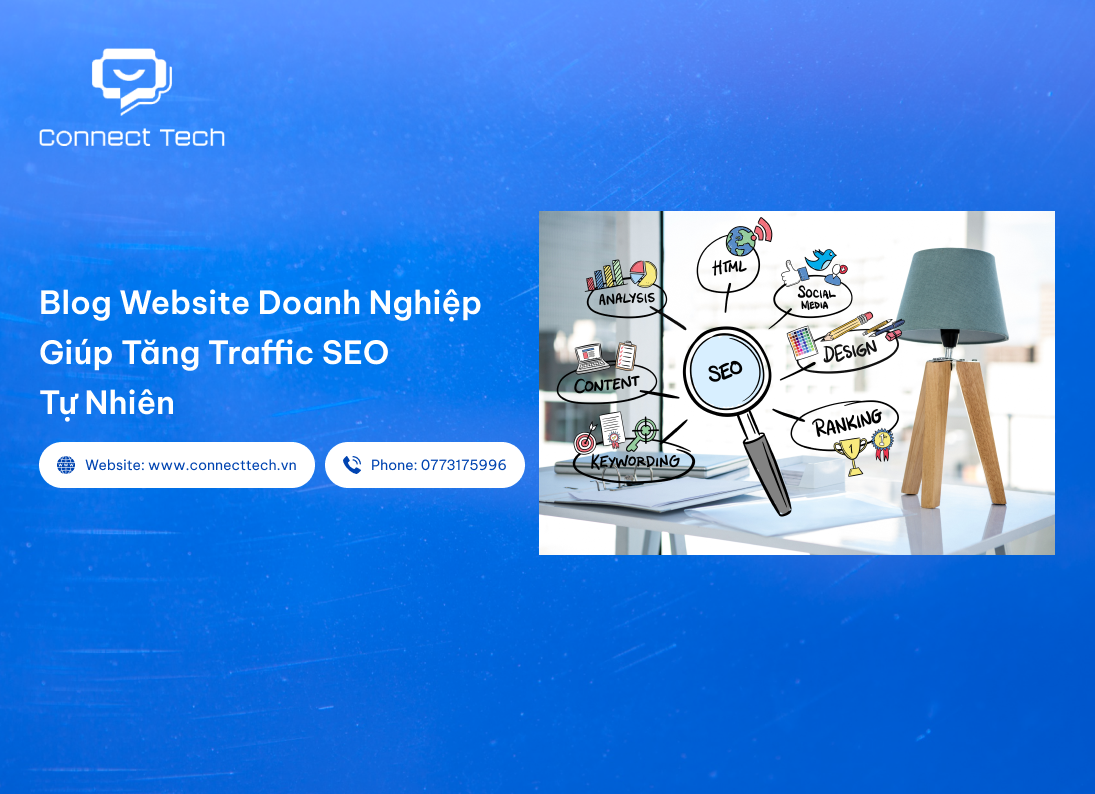
Business website blog helps increase organic SEO traffic
About Us Page
This is the page many businesses write most carelessly — yet it is also the strongest trust-building page. Customers read the About Us page when they are considering making a purchase or partnership, not when they are casually browsing.
This page should include: the founding story, core values, key team members (with real photos), and achievements/awards if available. Avoid writing generic statements such as “we are committed...” without concrete proof.
Services / Products Page
This is the most important conversion page — where customers decide whether to contact you or not. If you have multiple services/products, create an overview page along with separate subpages for each specific service/product.
For example, Connect Tech has a general “Services” page and subpages such as “Business Website Design,” “E-commerce Website Development,” and “Website Maintenance.” This structure helps customers find information more easily and is also beneficial for SEO.
Contact Page
It sounds simple, but many websites do it incorrectly. A contact page should include: a working contact form, click-to-call phone number, an address embedded with Google Maps, email address, and business hours. If there are multiple branches, each branch should have separate information.
Blog / Knowledge Page
A blog is not just a place to publish articles — it is the strongest long-term SEO channel for a website. Every article is an opportunity for the website to appear on Google with new keywords. Businesses without a blog are essentially allowing competitors to dominate organic search traffic.
Alt text: Business website blog helps increase organic SEO traffic
2. What Additional Pages Should Be Added Based on Business Type?
After having the five core pages, additional pages will depend on the industry. Below are specific suggestions for each business type.
Service Businesses (Agencies, Consulting, Education...)
| Recommended Page | Purpose |
|---|---|
| Projects / Portfolio Page | Demonstrate capabilities through real projects |
| Testimonials / Reviews Page | Increase trust and reduce decision barriers |
| FAQ Page | Answer questions before customers call |
| Dedicated Service Landing Pages | Optimize conversion for each service |
| Team Page | Highlight the people behind the brand |
Modern Website for E-commerce & Retail Businesses
For online sales businesses, website structures become significantly more complex. In addition to the basic pages, the following pages are also needed:
-
Product category pages (organized by category hierarchy)
-
Product detail pages (one page per product)
-
Cart & checkout pages
-
Policy pages (returns, warranty, shipping, privacy)
-
User account pages
The number of pages for this model can range from 50 to thousands depending on catalog size — and this is completely normal.
Local Businesses (Restaurants, Clinics, Spas...)
If you have a physical location and customers search nearby, prioritize:
-
Individual branch pages (if multiple locations exist)
-
Booking / reservation pages
-
Menu / service pricing pages
-
Promotions / special offers pages
Essential local business website pages for local SEO
Recommended Number of Website Pages Based on Business Size
To make it easier to apply, here is a specific reference framework based on business scale:
Small Businesses / Startups (1–10 Employees)
Recommended number of pages: 5–8 pages
At this stage, businesses need a website that launches quickly, costs less, yet still looks professional enough to create a strong first impression. Focus on content quality instead of page quantity.
Suggested structure: Homepage → About Us → Services/Products → Contact → Blog → (Projects page if applicable).
Modern Website for SME Businesses
Recommended number of pages: 10–20 pages
At this stage, businesses offer more services and need separate pages for each product/service line while investing seriously in SEO blogging. FAQ and Testimonial pages also become necessary to improve conversion rates.
Large Businesses (50+ Employees)
Recommended number of pages: 20–50+ pages
At this point, the website becomes almost a complete content ecosystem. Separate pages are needed for departments such as recruitment, investors, and partners, along with landing pages for each marketing campaign and a rich blog content library.
Common Mistakes When Building a Business Website Structure
Many businesses realize after building their website that they are making one of the following mistakes:
Many businesses create too many pages with shallow content just to make the website appear more “massive.” However, Google can recognize these low-value pages (thin content) and rank the website lower. Instead of creating many empty pages, focus on building fewer pages with truly useful and in-depth content for readers.
Ignoring separate pages for each service. Many websites place all services on a single page. This prevents each service from having its own SEO-friendly URL and makes it difficult for customers to find specific information. Every major service should have its own page. Not having a Blog page from the beginning is another common mistake among small businesses. They avoid blogging because they think “writing is time-consuming and nobody reads it,” but in reality, blogging is the best and most cost-effective SEO channel in the long run.
Missing Policy & Terms pages. Besides being a legal requirement, Privacy Policy and Terms of Service pages are also trust signals that Google highly values, especially for e-commerce websites.
How Connect Tech Consults Clients on Website Structure
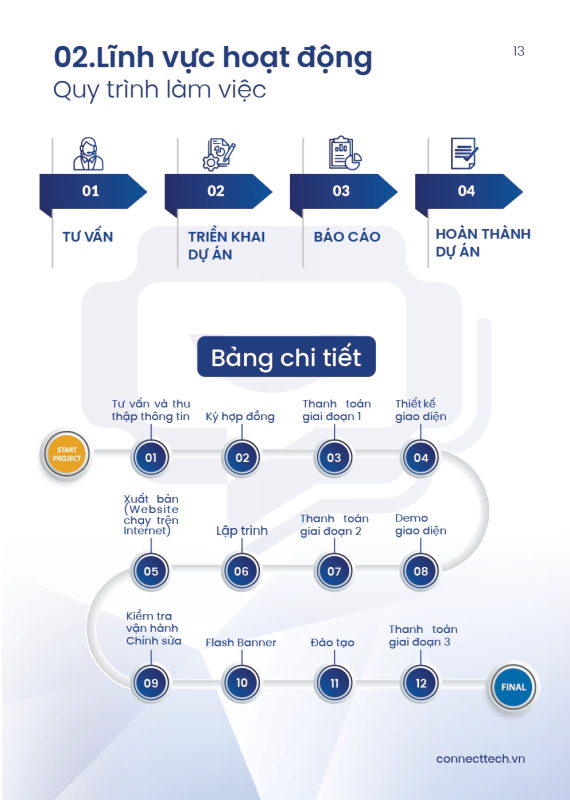
After many years of designing websites for businesses across various industries, Connect Tech applies a 3-step process when consulting website structures:
Step 1: Clearly Define Business Goals
Generate leads? Sell products directly? Build brand awareness? Each goal requires a different page structure.
Step 2: Understand Customers Before Designing the Website
What information do your customers usually search for before making a decision? From there, determine which pages should be created to “capture” them at each stage.
Step 3: Build the Sitemap Before Writing Content
A sitemap is the overall map of the website. Defining the full structure early helps avoid costly restructuring later.
Website Structure Consultation for Clients

Website Structure Consultation for Clients
Conclusion
There is no absolute answer to how many pages a business website should have, but one principle always remains true: every page must have a clear purpose that serves customers or a specific SEO objective. Small businesses should start with 5–8 core pages and gradually expand based on actual needs — this is the most effective and cost-efficient approach.
If you need consultation for an SEO-friendly website structure or want to upgrade your current website, Connect Tech is ready to help. Contact us today for a free consultation and receive a sitemap proposal tailored to your industry.
See more related articles:
Are Website Templates Really Cost-Effective for Businesses?
Why Are Cheap Websites Always “Expensive” Later?
Hidden Website Development Costs You Need to Know

Table of Contents