Loading Table of Contents...
Can a Landing Page Replace a Website? A Practical Perspective
Both landing pages and websites are essential tools in B2B marketing, but they serve different purposes. Landing pages are designed to maximize conversions for advertising campaigns, while websites support brand building, SEO growth, and long-term credibility. This article explores the differences between the two platforms, the advantages and disadvantages of each solution, and helps businesses determine when to use a landing page, a website, or a combination of both for the best results.
Many B2B businesses, when starting to implement online marketing, often ask the same question: can a landing page replace a website? This is a very common concern, especially among businesses that want to optimize their budget or need to launch quickly for advertising and customer acquisition purposes. However, when viewed from the perspective of operations and long-term growth, landing pages and websites actually serve two completely different roles. Misunderstanding the function of each platform can lead businesses to invest in the wrong direction, resulting in situations where they spend heavily on advertising but fail to build their brand or establish trust with B2B customers.
Connect Tech will provide a detailed analysis of the differences between landing pages and websites, while helping businesses determine when to use each solution to achieve the best results.
Landing Pages and Websites Are Two Different Tools
Many people assume that a landing page is simply a simplified version of a website. In reality, this is not the case. These two platforms differ in their purpose, content structure, and the way they guide user behavior.
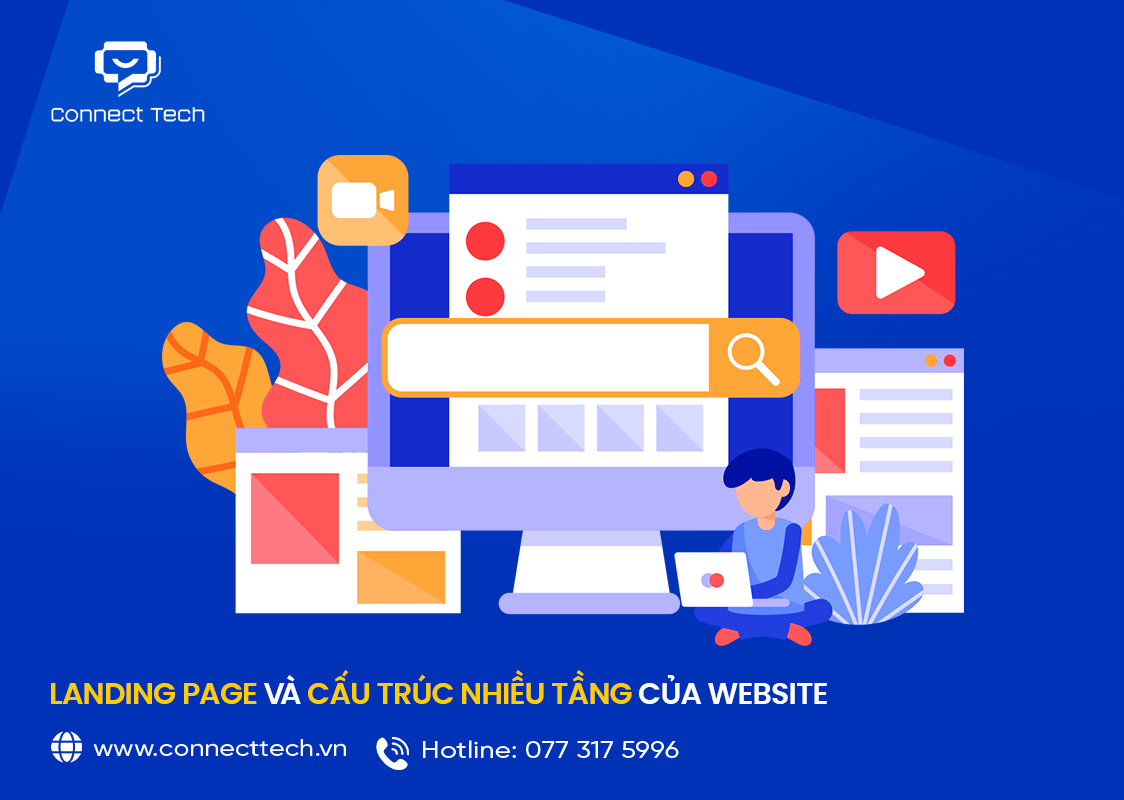
Landing Page and the Multi-Level Structure of a Website
What Is a Landing Page?
A landing page is a single web page designed to serve one specific objective. Rather than providing a wide range of information like a website, a landing page focuses entirely on encouraging users to take a single action, such as filling out a form, registering for a consultation, requesting a quotation, or signing up for a product trial. The most important characteristic of a landing page is its ability to eliminate distractions. Users visiting the page will not see navigation menus or numerous secondary links. Every piece of content on the page is built around a clear CTA with the goal of increasing conversion rates.
For example, if a business is running Google Ads for B2B website design services, directing users to a dedicated landing page containing service information and a “Get a Quote Now” button is often much more effective than sending them to the homepage of a website filled with various unrelated content.
What Is a Business Website?
While a landing page focuses on short-term conversions, a website serves as the overall information platform of a business. A complete website typically includes multiple pages such as About Us, Services, Blog, Portfolio, Case Studies, and Contact. Unlike a landing page, a website serves multiple types of users at different stages of the buying journey. Some visitors come to learn about the brand, others want to review completed projects, while some need to read educational content before making a decision.
For B2B businesses, a website also functions as a platform to demonstrate expertise and professionalism. Customers rarely make a decision based solely on an advertisement. They often research a company’s profile, implementation experience, real-world projects, and credibility before deciding to make contact or enter into a partnership.
Landing Page vs. Website: Where Are the Differences?
Both landing pages and websites are digital marketing tools, but they operate in very different ways. Landing pages are created to support a specific campaign, so they are faster to build, have a simpler structure, and often achieve higher conversion rates. This is why many businesses use landing pages when running Google Ads or Facebook Ads campaigns for webinars, events, or individual services.
Meanwhile, a website is a long-term asset. In addition to introducing the business, a website supports SEO, brand building, and organic traffic generation from Google. This is particularly important for B2B businesses with long sales cycles that require multiple touchpoints before customers make a decision.
| Criteria | Landing Page | Business Website |
|---|---|---|
| Objective | One specific conversion action | Multiple objectives and audience groups |
| Number of Pages | Single page | Multiple interconnected pages |
| Navigation | No menu | Full menu and sitemap |
| Organic SEO | Limited | Strong and scalable across many keywords |
| Development Time | Fast | Longer depending on scope |
| Initial Cost | Lower | Higher |
| Conversion Rate | Usually higher | Lower due to more options |
| Brand Credibility | Moderate | High |
| Best For | Short-term advertising campaigns | Long-term branding and SEO |
| Blog/Content | No | Yes |
Can a Landing Page Replace a Website?
The answer depends on the business’s growth objectives. If a company only needs a tool to run advertisements, generate leads quickly, or test market demand over a short period, a landing page can be highly effective. It is an ideal solution for startups launching a new product or campaigns with a specific timeframe. However, if a business wants long-term growth, SEO investment, or a professional image in the B2B sector, a landing page alone will not be sufficient to replace a website.
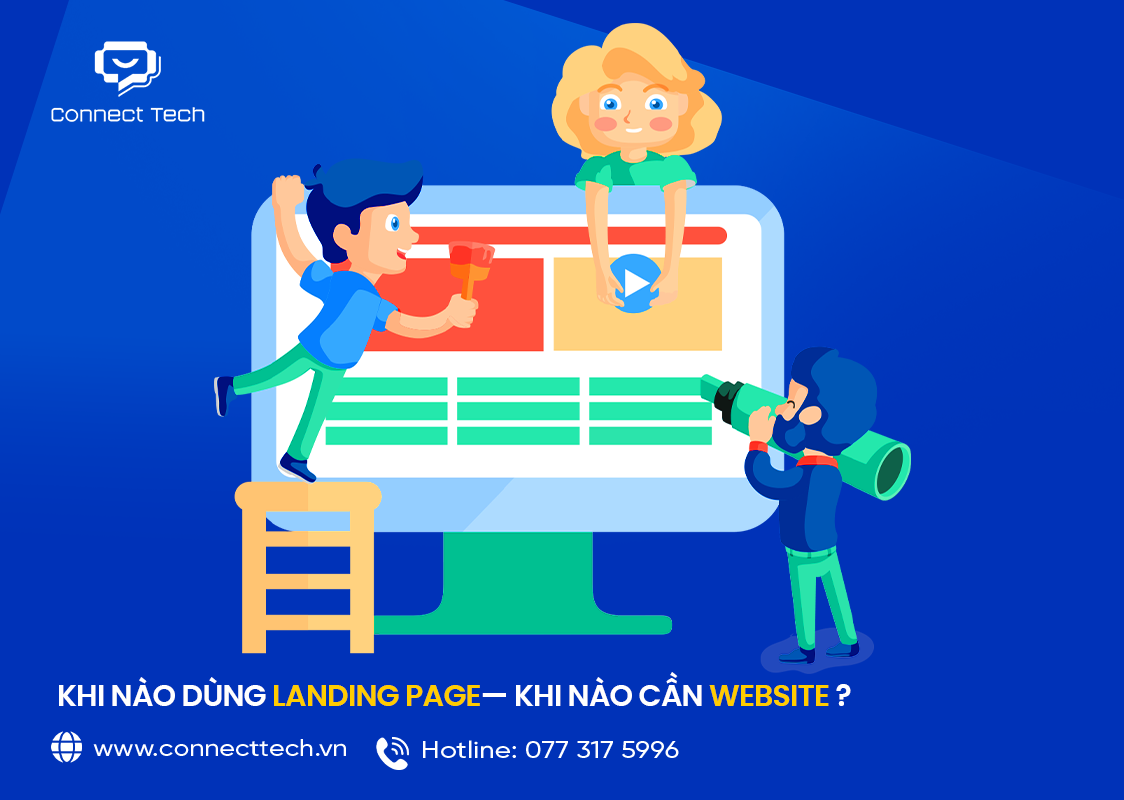
When Should You Use a Landing Page — and When Do You Need a Website?
When a Landing Page Can Be Effective
In the early stages, many startups use landing pages to test market response before investing a large budget in a website. A simple landing page with a registration form or pre-order option is often enough to measure customer interest. In addition, landing pages are highly effective for short-term advertising campaigns such as webinars, workshops, or seasonal promotions. When all content revolves around a single message, conversion rates are often significantly higher than those of a standard website.
For offline businesses that are just beginning their digital transformation journey, landing pages also provide a way to establish an online presence quickly without requiring a substantial initial investment.
When a Website Is Essential
For B2B businesses, customers usually need more time to conduct research before entering into a partnership. They want to review company profiles, completed projects, team information, work processes, and real case studies. This type of content needs to be organized systematically on a website and cannot be effectively condensed into a single landing page. A website also plays a critical role for businesses that want to develop SEO. Landing pages can only be optimized for a limited number of keywords, whereas a website allows content expansion across multiple topics to increase organic traffic from Google.
In addition, when a business offers multiple products or services, a website helps organize information more clearly and creates a more comprehensive research experience for potential customers.
When Should a B2B Business Use a Landing Page?
In B2B marketing, landing pages are most effective when used as a supporting component of a website rather than operating independently. For example, instead of directing advertising traffic to a general service page on the website, a business can create a dedicated landing page focused entirely on one specific solution. This approach makes the message clearer and increases conversion potential.
Landing pages are also particularly suitable for B2B SaaS products or software solutions that require demos or free trials. A landing page featuring a short introduction video, key benefits, and a registration form often performs better during the early stages of the marketing funnel. For industry webinars or events, a dedicated landing page also allows businesses to measure the effectiveness of each advertising channel more accurately.
When Should a B2B Business Use a Landing Page?
When Does a Business Absolutely Need a Website?
If a business wants to build a long-term brand or develop a sustainable marketing strategy, a website is almost indispensable. When potential customers search for a business using various keywords on Google, a website expands visibility through blogs, service pages, and in-depth content. This is something a landing page cannot accomplish effectively.
A website is also essential when a business wants to showcase its capabilities through portfolios and case studies. In the B2B environment, customers often evaluate professionalism based on how a company presents its real-world projects and implementation experience. Furthermore, if a business offers multiple services or products, a website helps organize content more clearly and provides users with a complete and structured research experience.
Should You Choose a Landing Page or a Website?
To determine the right solution, businesses should focus on their actual objectives rather than comparing only cost or implementation speed. If the goal is to generate quick conversions for a specific advertising campaign, a landing page is generally the more suitable choice.
On the other hand, if the objective is to build a brand, increase SEO traffic, and establish a long-term marketing foundation, a website is the necessary solution. In practice, most successful B2B businesses today use both. The website serves as the brand foundation, while landing pages are used to optimize conversion rates for individual campaigns.
What Solution Does Connect Tech Recommend for B2B Businesses?
Through the process of developing websites for many B2B businesses in Vietnam, Connect Tech has found that the most effective model is often a combination of a website and landing pages within the same marketing ecosystem. A website helps businesses build a professional image, develop SEO, and establish credibility with potential customers. Meanwhile, landing pages help optimize advertising performance and increase conversion rates for specific campaigns.
If your business is in its early stages and operating with a limited budget, Connect Tech can help create a suitable implementation roadmap, allowing you to develop step by step without spreading your investment too thin while still ensuring long-term effectiveness.
Conclusion
Landing pages and websites are not tools that replace one another. Each platform serves its own role within a company’s marketing strategy and brand development efforts. Landing pages are ideal for optimizing conversions in specific campaigns, while websites provide the foundation for building a professional image and achieving sustainable growth in the digital environment. Understanding the role of each tool allows businesses to invest more effectively and gain a long-term competitive advantage in the B2B sector.
Connect Tech is always ready to accompany you on your journey to build and develop a professional website. If you need consultation or have any questions, please contact us via our free consultation Hotline at 077 317 5996 or email us at info@connecttech.vn for prompt and dedicated support.
Related Articles
Agency vs. Freelancer for Website Development: Which One Should You Choose?
How Does UX/UI Affect Revenue?
How Many Pages Does a Business Website Need to Operate Effectively?
Table of Contents
Related news
Professional & Affordable Real Estate Website Design to Increase Closing Rates
Professional, affordable real estate website design optimized for UX/UI, SEO, speed, and functionality — helping businesses build credibility, generate leads, and increase conversion rates.
Why Does a Website Have No Traffic? Causes & Effective Solutions
Why does your website have no traffic? Connect Tech analyzes the five most common causes and provides practical solutions to help your website generate sustainable organic traffic. Contact us for expert consultation today!
Website Lead Generation: How Many Leads Per Month? Calculation Formula
How many leads should your website generate each month? Connect Tech explains the lead calculation formula, industry benchmarks, and proven strategies to optimize your website for sustainable lead generation and higher conversions.
When Should You Upgrade Your Website?
Wondering when to upgrade your website? Connect Tech highlights 7 key signs, the benefits, and website upgrade costs to help businesses optimize performance, improve user experience, and retain more customers.
Does Your Website Need CRM Integration? A Complete Guide
Does your website need CRM integration? Connect Tech explains the benefits, the right time to integrate CRM, and the best implementation approach to help businesses improve customer management and sales performance.
What's the Difference Between a Rental Website and an Owned Website?
What’s the difference between a rental website and an owned website? Connect Tech compares costs, ownership, advantages, and limitations to help businesses choose the right solution. Get a free consultation today!