Loading Table of Contents...
Why Do Service Industry Websites Fail to Generate Leads? Solutions and Fixes
Learn why your service website isn't generating leads and explore effective strategies to improve conversions and attract more potential customers.
Many businesses invest significantly in website design, SEO, and online advertising but still fail to generate the expected number of leads. In reality, a website with high traffic does not necessarily generate more sales. If users cannot find the information they need or encounter difficulties during navigation, they will quickly leave the site without providing any contact information.
For a website to truly become a revenue-generating tool, businesses need to optimize technical factors, content, and user experience simultaneously. Below are the common reasons why service websites fail to generate leads and effective solutions to address them.
Why Do Service Websites Need to Focus on Lead Conversion?
For service businesses, a website is not only an information channel but also a system that continuously captures potential customers. A properly developed website helps businesses reach customers, enhance brand awareness, and increase conversion opportunities.
On the other hand, if a website only serves as an introduction and does not encourage users to take actions such as making a phone call, filling out a form, or requesting a consultation, the entire marketing investment will struggle to deliver the desired results.
Reasons Why Service Websites Fail to Generate Leads
Before looking for solutions, businesses need to accurately identify the bottlenecks that are reducing conversion performance on their websites.
Slow Page Loading Speed
The time it takes for a website to display content significantly affects user satisfaction and their willingness to continue interacting with the site. When a website takes too long to load, most visitors will leave before learning about the services.
The causes often stem from unoptimized images, source code containing unnecessary files, or hosting systems that cannot handle data processing demands. In addition, failing to implement technologies such as caching or a CDN also prolongs website response times.

Slow page loading speed reduces lead generation.
Poor Mobile User Experience
Today, most users search for services through smartphones. Therefore, if a website does not display properly on mobile devices, businesses may lose a large number of potential customers.
Common issues include broken layouts, inconsistent image displays, difficult-to-use forms, or contact buttons that are too small. These problems force users to spend more time searching for information and make them more likely to leave the website.
Unoptimized Website Structure and Technical SEO
A complex website structure not only creates difficulties for users but also reduces the ability of search engines to understand and effectively index website content.
Many service websites still suffer from issues such as improper heading structures, unclear URLs, complicated navigation, or a lack of internal links. In addition, problems such as duplicate titles, missing meta descriptions, or broken links also reduce SEO effectiveness and negatively impact customer acquisition.
Content Does Not Address User Needs
Many businesses focus on introducing products and services but forget to provide the information that customers genuinely care about.
An effective service page should answer questions such as: What benefits does the service provide? What is the process? How much does it cost? Why should customers choose the business? When content is too superficial or lacks expertise, users find it difficult to make decisions, and conversion rates decline significantly.
Lack of Clear Calls to Action
Even when customers are interested in a service, they may still leave the website if they do not know what to do next.
Many websites place contact buttons in hard-to-see locations, use colors that do not stand out, or require users to fill in too much information on registration forms. These barriers significantly reduce the likelihood of customers leaving their contact information.
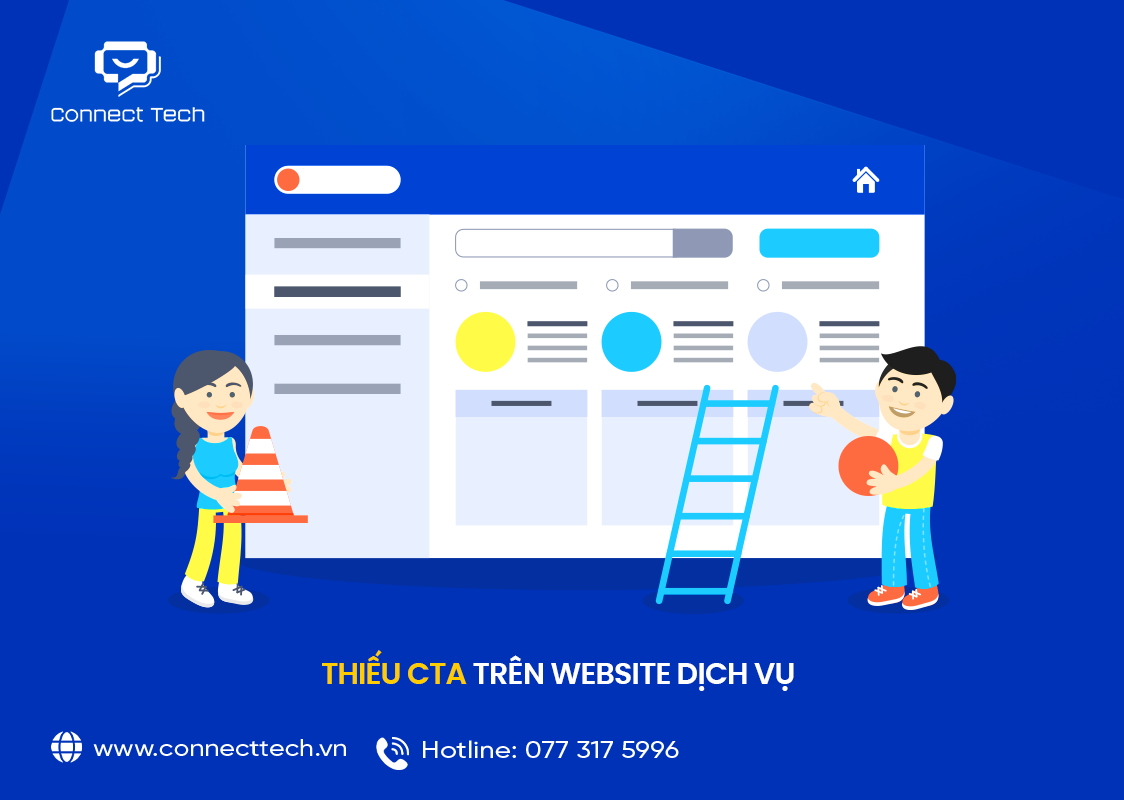
Lack of CTAs on service websites.
Signs That Your Website Is Losing Potential Customers
Businesses should review their websites if the following situations occur:
-
Traffic increases, but the number of calls and registration forms does not improve.
-
Users leave the page after only a short period of time.
-
Advertising costs continue to rise, but the number of leads does not increase proportionally.
-
Keywords achieve good rankings, but revenue shows no positive changes.
These are signs that the website is experiencing problems in the conversion journey and needs optimization.
Solutions to Improve Conversion Rates for Service Websites
To improve lead generation performance, businesses need to implement multiple solutions simultaneously, from technical optimization to content development.
Optimize the Interface and Customer Journey
Businesses should optimize image sizes, reduce unnecessary code, and ensure that the website displays properly across all devices.
In addition, contact buttons should be placed in visible locations, with appropriate sizes and prominent colors. Integrating Live Chat or Zalo also helps customers connect with the business immediately when they have a need.
Build a Topic-Based Content System
Instead of publishing fragmented content, businesses should build related topic clusters to create strong connections between pages.
The content system may include:
-
Main service pages.
-
Detailed service pages.
-
Sections for updates, insights, and analytical articles related to the business field.
-
Frequently Asked Questions sections.
-
Projects and real case studies.
This approach helps users easily find information while also helping search engines better understand the website's topics.
Simplify the Information Collection Process
Registration forms should not require too many data fields. Basic information such as full name, phone number, email address, and consultation requirements is sufficient for businesses to contact customers.
A concise and user-friendly form will significantly increase completion rates.
Regularly Monitor User Behavior
Tracking data from Google Analytics, Google Search Console, or heatmap tools helps businesses better understand how users interact with their websites.
Through this data, businesses can identify where users commonly leave the site, which content attracts the most attention, and which factors are hindering conversions.

Optimize conversions for service websites.
Conclusion
A service website's inability to generate leads is often the result of multiple issues occurring simultaneously, from page loading speed and user experience to content structure and conversion systems. Regularly reviewing, updating, and optimizing the website not only improves SEO performance but also helps increase conversion rates and revenue. If a business is struggling to attract customers through its website, reviewing and optimizing the entire system is a necessary step toward building an effective and sustainable online business platform.
Contact Information
Address: 965/36/9 Quang Trung, An Hoi Tay Ward, Ho Chi Minh City, Vietnam
Website: https://connecttech.vn
Hotline: 077 317 5996
See more related articles:
5 Mistakes to Avoid When Building a Construction Industry Website
How Should a Manufacturing Company Website Be Built?
What Does a Real Estate Website Need to Generate Leads? Technical Requirements
Table of Contents
Related news

How Should a Manufacturing Company Website Be Built?
A manufacturing company website should be SEO-friendly and optimized for B2B operations to enhance credibility, attract potential clients, and improve business efficiency.

Website SEO Checklist: Standards for Building and Optimizing Content
A comprehensive website SEO checklist helps businesses optimize both On-page and Technical structures. Refer to the guide from Connect Tech to improve search rankings.

Checklist UX/UI Website: Professional Interface Design Standards
Discover a detailed website UX/UI checklist to optimize user experience. Technical design guidelines and SEO standards from Connect Tech agency. Read now!
Advanced Technical Business Website Checklist
A professional business website checklist is a set of technical standards for optimizing source code, speed, and security. Applying this checklist helps websites operate stably, secure data, and achieve higher rankings on Google.

Laravel vs Next.js vs WordPress: Which Platform Is Best?
The choice of a development platform directly impacts the performance, scalability, and long-term maintainability of a business website. Each technology offers distinct technical advantages designed to address different business requirements and project objectives. This article provides an objective comparison of Laravel, Next.js, and WordPress, helping businesses gain a clear understanding of each platform before starting their web development project with Connect Tech.